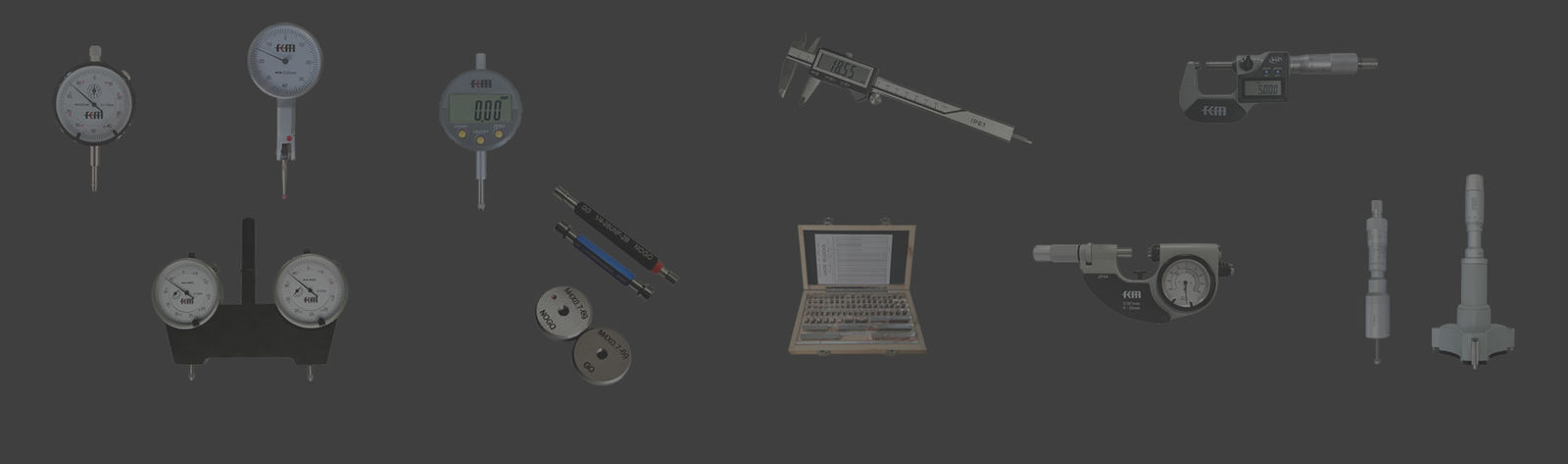
The micrometer, as an important tool in precision measuring instruments, is widely used in various technical fields
such as mechanical manufacturing, precision processing, and quality inspection. Its measurement accuracy can reach
0.001 millimeters, and the measurement range varies from 0-25 millimeters to 375-400 millimeters and other
specifications. It can meet the precise measurement requirements of different geometric quantities such as outer
diameter, inner diameter, depth, and thread. The measurement principle of the micrometer is based on precise screw
transmission. The standard pitch is 0.5 millimeters, and the graduation value of the differential cylinder is 0.01 millimeters.
Through the vernier reading, a reading accuracy of 0.001 millimeters can be achieved. In the aerospace, automotive
manufacturing, and precision machinery industries, the micrometer is an indispensable measuring tool for ensuring
product quality and process accuracy.

I. Precision Dimension Control in Mechanical Manufacturing
1. The measurement of the outer diameter of shaft parts is the most typical application scenario of micrometers,
especially suitable for the detection of precision shaft parts with tolerance grades of IT6-IT9. During the lathe
processing, using a micrometer can monitor the diameter changes of the workpiece in real time, ensuring that
the dimensional accuracy is controlled within ±0.005 millimeters. For shaft parts with complex shapes such as
stepped shafts and eccentric shafts, the micrometer can measure the diameters of different sections. During the
measurement process, it is important to ensure the stability of the workpiece temperature to avoid the influence of
thermal deformation on the measurement accuracy. Select an appropriate specification of the micrometer to ensure
that the measured dimension is within the middle two-thirds of the range of the measuring instrument.
2. The outer diameter and wall thickness of sleeve-type parts need to be precisely measured using a micrometer.
Especially for thin-walled sleeves, the uniformity of the wall thickness must be tested. When measuring the wall
thickness, multiple points should be measured in the circumferential direction to ensure that the thickness
difference is controlled within 0.02 millimeters, avoiding stress concentration and deformation caused by
uneven wall thickness. For high-precision parts such as precision bearing rings and hydraulic cylinder sleeves,
the measurement accuracy of the micrometer should reach 0.001 millimeters. During the measurement process,
the measurement force should be controlled to avoid elastic deformation of thin-walled workpieces.
3. The precise measurement of sheet thickness is an important application of micrometers in metal processing,
particularly suitable for the thickness control of precision stamping parts and thin plate welding components.
The tolerance for steel plate thickness is usually ±0.1 millimeter. Using a micrometer enables the detection of
thickness changes and timely identification of rolling defects and material issues. Measuring the thickness
values at different positions and drawing a thickness distribution map is helpful for analyzing process quality.
For composite materials and non-metallic sheets, an appropriate measurement surface shape and measurement
force should be selected.
II. Online Inspection in the Precision Processing Procedure
1. The online inspection of workpiece dimensions in CNC machining centers can be achieved using micrometers,
which enables rapid and accurate dimension control, thereby avoiding the generation of batch defects. Dimension
inspection is conducted between rough and finish machining processes, and the subsequent machining allowance
is adjusted based on the measurement results to ensure that the final dimensional accuracy meets the
requirements specified in the drawings. Pneumatic or electric micrometers can be configured on the automated
production line to achieve automated measurement and data collection. The measurement data can be fed back to the
CNC system to achieve closed-loop control and adaptive processing.
2. During the grinding process, a micrometer is used to monitor the changes in the workpiece dimensions, and to control
the grinding allowance and surface quality. For precision grinding, the dimensional tolerance should be controlled within
the range of 0.002 - 0.005 millimeters. The high precision of the micrometer can meet the strict requirements
of the grinding process. During the grinding process, attention should be paid to controlling the temperature of the
workpiece, as high temperature will affect the measurement accuracy and the stability of the workpiece dimensions.
Select an appropriate measurement time and avoid measuring during the period when the workpiece is undergoing
thermal deformation.
3. In precision turning and boring processes, the micrometer is used to monitor the dimensional changes during the
cutting process, especially for the control of precise hole diameters and outer circumferences. The optimization of cutting
parameters needs to be adjusted based on the actual measurement results. Through the analysis of the data
measured by the micrometer, the wear condition of the cutting tool and the changes in the cutting state can be
determined. Establishing a dimensional change curve is helpful for predicting the timing of tool replacement.
For deep hole processing and processing of slender shafts, the influence of cutting force and clamping force on the
deformation of the workpiece should be considered.
III. Quality Inspection and Application of Measurement Standards
1. During the incoming inspection process, a micrometer is used to measure the dimensional accuracy of raw materials
and purchased components to ensure compliance with technical requirements. Standard components such as bearings
and fasteners require strict dimensional inspection. The micrometer can quickly and accurately measure key
dimension parameters, thereby improving inspection efficiency and reliability. An inspection database is
established to track the quality changes of suppliers. For large batches of parts, a sampling inspection plan is adopted,
and reasonable inspection frequencies and sample quantities are determined.
2. The finished product inspection uses a micrometer to verify the processing quality and assembly accuracy, ensuring
that the products meet the design requirements and customer standards. The measurement of key dimensions requires
traceability and reproducibility. The calibration certificate of the micrometer and the evaluation of measurement
uncertainty are important components of the quality system. The measurement environment should comply with
the requirements of the metrology standards, with the temperature controlled within a range of 20 ± 2 degrees Celsius.
The measurement personnel should undergo professional training and master the correct measurement methods
and reading skills.
3. The measurement laboratory and the standard laboratory use micrometers as the transfer tools for length
measurement, participating in the transmission and comparison verification of measurement values. High-precision
micrometers can serve as working standards, calibrating other measuring instruments and testing equipment,
with measurement uncertainty reaching the level of 0.001 millimeters. They participate in international comparisons
and proficiency testing projects to verify measurement capabilities and technical levels. They establish measurement
standard devices to provide calibration services for the company's measuring instruments.