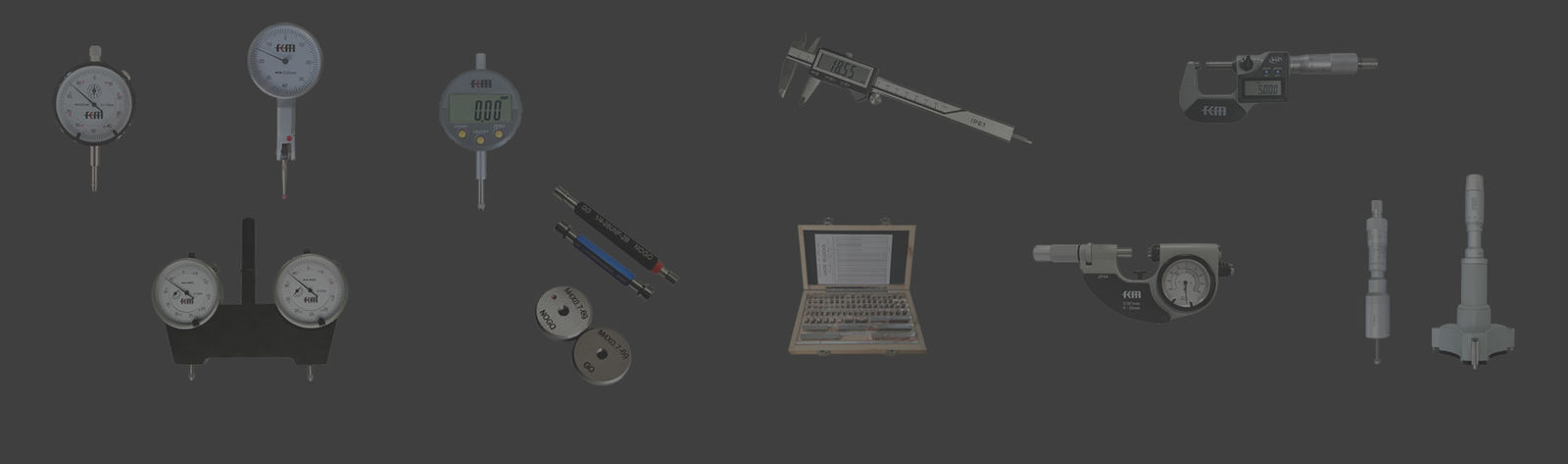
The micrometer head is installed on measuring instruments and precision machinery and is a precision device widely
used for measurement, feed, positioning, etc. In recent years, with the advancement of technology, its application scope
has further expanded. Besides being used in combination with measuring fixtures, it has also been widely adopted
in precision feed devices, cross-moving worktables for laser equipment, controllers, and other applications.

As the application scope expands, the demands of customers also become more diverse. Even for standard-style general
products, there are various models with different measurement ranges, shaft sleeve shapes, total lengths, etc.,
and they can be selected according to the purpose.
How to select the type of micrometer head?
The key points for selecting the micrometer head mainly include the measurement range, the measurement surface,
the shaft sleeve, the scale specification, and the size of the differential cylinder, etc.
1. Measurement range (travel distance)
Please select a measurement range that is larger than the estimated travel. The standard model is available
in 6 ranges from 5mm to 50mm. Even if the estimated travel is only 2mm to 3mm, if the installation space is sufficiently
spacious, choosing the 25mm model is more economical. When a long travel of more than 50mm is required,
it can be solved by using it in combination with gauge blocks.
2. Sleeve
The shaft sleeve serves as the retaining part of the micrometer head. Its shape is divided into
"straight handle type" and "with locking nut type".
→ Axial sleeve with locking nut
The installation method of the shaft sleeve type with locking nuts is relatively simple and can provide a firm fixation.
→Straight handle bushing
The straight handle sleeve type requires processing such as crack clamping and adhesive bonding, but it has a wide
range of applications and can also be adjusted slightly in position in the front and rear directions during the
final installation.
3. Plane Of Measurement
When used as a measuring device, the planar type is more commonly used.
When used as a feed device, the spherical type can minimize the error caused by the inclination of the measuring
head installation part. When the relative positional relationship is not very stable and higher precision is required,
it is recommended to use a rotation prevention device.
4. Micrometer screw pitch
Standard pitch: 0.5mm.
Fast feed: 1mm pitch, enabling rapid positioning and having stronger load-bearing capacity.
Fine feed: 0.1mm pitch, 0.25mm pitch, facilitating micro-motion feed and precise positioning.
5. Constant force measuring device
When used as a measuring instrument, it is recommended to be equipped with a constant force-measuring device.
When used as a stop block or if space-saving is the priority, please consider using without a constant
force-measuring device.
6. Scale Specifications
When used as a measuring instrument or when specifying the movement amount, attention should be paid to
the scale specifications.
The same scale specification as the external diameter micrometer is called "positive scale" and it is of the standard type.
The scale values increase in the direction opposite to the contraction of the measuring screw. On the contrary, the scale
values increase in the direction opposite to the extension of the measuring screw are called "reverse scale" specifications.
"Positive and reverse scale" specifications can be easily read in both positive and reverse directions.
The numbers are marked in black and red respectively, making reading simple and easy. The measuring head is also
equipped with a counter-type and a digital display type that can directly read the measurement values.
The digital display type can also record and calculate the measurement values by outputting the measurement data.
7. Outer diameter of the differential cylinder
The diameter of the differential cylinder has a significant impact on the "precision" of operation and positioning.
A small-diameter differential cylinder enables fast positioning, while a large-diameter differential cylinder can perform
precise positioning and reading. Additionally, there are models with speed control devices available for the large-diameter
differential cylinder to enhance its operability.