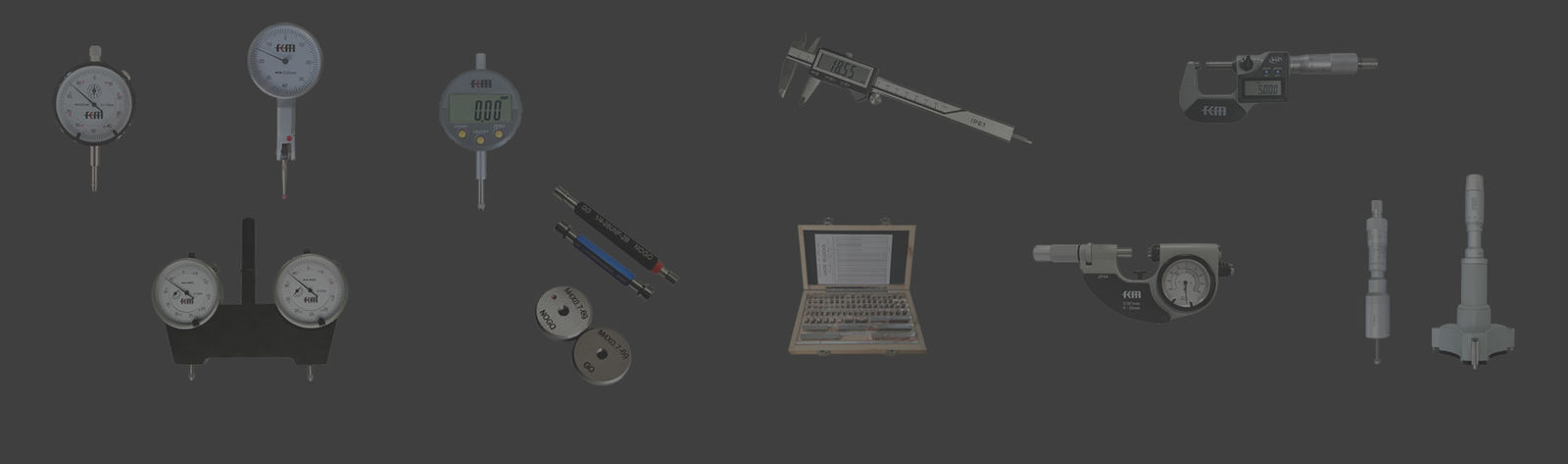
In modern industrial production, the application of dial indicators is far more than simple size measurement;
they are indispensable quality control tools in precision manufacturing. When you hold a dial indicator with an accuracy
of 0.001 millimeters in your hand, it might be hard to imagine that this seemingly simple device can provide such precise
guarantees for product quality. In fact, the key role of dial indicators in precision measurement covers a wide range
of applications from basic size inspection to complex form and position tolerance measurement, and they are important
fundamental tools for achieving precision control in modern manufacturing.

Q: What level of measurement accuracy can a dial indicator achieve?
A: The resolution of a standard dial indicator is typically 0.01 millimeters, while high-precision dial indicators can reach
0.001 millimeters or even 0.0001 millimeters. In practical applications, the indication error of a grade 0 dial indicator
does not exceed ±0.003 millimeters, which is fully capable of meeting the quality inspection requirements of precision
mechanical processing. However, it should be noted that the actual measurement accuracy is also affected by factors
such as the operation method, environmental conditions, and the surface quality of the measured part.
Q: What are the advantages of a micrometer compared to other measuring tools?
A: The main advantages of a micrometer include: high measurement accuracy, simple operation, relatively low cost,
and wide application range. Compared with a vernier caliper, the micrometer has obvious advantages in relative
measurement and form tolerance detection; compared with a three-coordinate measuring machine, the micrometer is
more suitable for rapid detection in the production site. Especially in the online quality control during batch production,
the micrometer plays an irreplaceable role.
Q: How can one use a dial indicator correctly to ensure measurement accuracy?
A: When using a dial indicator correctly, the following points should be noted: Before measurement, perform zero
calibration; Keep the measuring rod perpendicular to the surface being measured; Apply an appropriate measuring force
(usually 0.8 - 1.2 Newtons); Avoid excessive movement of the measuring rod causing the pointer to rotate more than
one full circle; Regularly conduct precision checks and maintenance. At the same time, control the environmental
temperature within the range of 20 ± 2 degrees Celsius to ensure the accuracy and reproducibility of the
measurement results.
Q: Under what circumstances is a dial indicator not suitable for use?
A: The dial indicator is not suitable for the following situations: when the surface being measured is too rough
(Ra > 3.2 micrometers); when the absolute size needs to be measured; when the shape of the measured object is too
complex and the measuring rod cannot make proper contact; in environments with significant vibration; or when a large
amount of data recording and analysis is required for automated measurement. In these cases, it is recommended
to choose other more appropriate measuring tools or methods.
The usage purpose of a dial indicator covers various aspects ranging from basic dimension measurement to complex
geometric accuracy control. It is not only a measuring tool but also an essential guarantee for achieving precise control
in modern manufacturing. With the development of intelligent manufacturing technology, traditional dial indicators are
integrating with digital technology to form more intelligent measurement solutions. Mastering the correct usage methods
and application skills of dial indicators is of great practical significance for improving product quality and production efficiency.