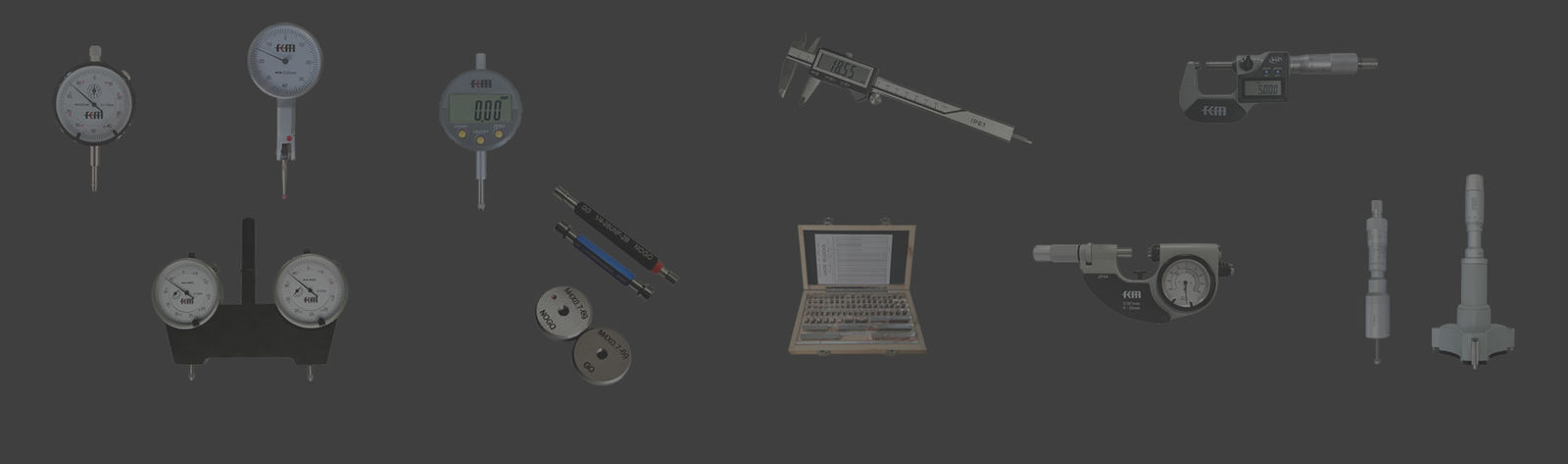
Gauge blocks, as the benchmark for precise measurement, play an indispensable role in modern industrial production.
This article will delve into the role of gauge blocks in precise measurement and, by combining practical application cases,
analyze their significance in the industrial field, hoping to provide readers with a clearer understanding.
I. What is a gauge block?
1. A gauge block, also known as a slip gauge, is a precision measuring tool with two parallel measuring surfaces.
Its function is to serve as a length standard for calibrating other measuring tools or for direct precision measurement.
2. Gauge blocks are typically made of materials with high hardness and stability, such as steel, ceramic or carbide,
to ensure their dimensional accuracy and stability. The choice of material directly affects the precision and service
life of the gauge blocks.
3. Gauge blocks are classified according to their precision grades. Gauge blocks of different grades are suitable for
different measurement scenarios. The higher the precision, the higher the manufacturing and calibration costs.

II. The Role of Gauge Blocks in Precision Measurement
1. Calibration of measuring tools: Gauge blocks can be used to calibrate various measuring tools, such as
micrometers, dial indicators, height gauges, etc., to ensure the accuracy of these measuring tools. This is one of
the main applications of gauge blocks.
2. Setting the measurement reference: In some precise measurement scenarios, the measurement reference can be
directly set using gauge blocks. For instance, in machine tool processing, gauge blocks can be used to establish
the processing dimensions of the workpiece.
3. Measuring workpiece dimensions: Gauge blocks can be used to check the dimensional accuracy of workpieces,
such as measuring the diameter of shafts or the depth of holes.
III. The Importance of Calipers in Industry
1. Ensuring Product Quality: In industries such as mechanical manufacturing, aerospace, and automotive
manufacturing, the requirements for the dimensional accuracy of parts are extremely high. Using calipers for
precise measurement and calibration can effectively ensure the quality of the products.
2. Enhance production efficiency: By using calipers to calibrate measurement tools, measurement errors can be
reduced, measurement efficiency can be improved, and thus production efficiency can be enhanced.
3. Promoting technological progress: As the foundation of precise measurement, the accuracy and stability of
gauge blocks directly influence the advancement of industrial technology. The emergence of higher-precision gauge
blocks has driven the development of precision processing technology.
IV. Usage and Precautions of Calipers
1. Combination of calipers: Multiple calipers can be used in combination to achieve the desired size. When combining,
attention should be paid to the contact between the calipers to ensure a good contact and avoid errors.
2. Maintenance of gauge blocks: Gauge blocks are precision measuring tools and require proper storage
and maintenance. After use, they should be cleaned thoroughly, coated with anti-rust oil, and stored in a dry and
constant-temperature environment.
3. Calibration of gauge blocks: The accuracy of gauge blocks will decrease over time due to usage. Regular calibration
is necessary to ensure their measurement accuracy.